Why Is My New Website Not Getting Traffic and How to Fix It?
- by Ilona K.

Table of contents
Launching a new website can feel strangely quiet. The pages are live, the domain works, and yet the traffic graph barely moves.
For a new business website, low traffic can have several causes. Search engines may not have indexed the pages yet, the content may target searches with little demand, or potential customers may see the business in search results without clicking.
The frustration is common. This question on Reddit comes from a website owner publishing regularly but still struggling for visibility, while a similar Quora discussion asks why SEO activity does not always translate into traffic.
Learn why your website gets no traffic, how to diagnose the cause, and how businesses can build more useful traffic over time.
Why Your Website Gets No Traffic: Diagnose the Problem First
A blank-looking analytics report does not always mean nobody visited the website. Sometimes the first problem is measurement.
Google Analytics 4 (GA4) and Google Search Console answer different questions. GA4 records visits from channels such as direct search, social media, email, and different types of advertising. Search Console shows whether pages appear on Google, including organic search metrics - impressions, clicks, and search queries.
If Search Console records clicks while GA4 appears unusually quiet, tracking may be the issue. Missing tags, consent settings, cross-domain journeys, or campaign tagging can affect reporting. Our guide explains how to fix 'unassigned' traffic in GA4.
If both impressions and visits sit close to zero, the problem is more likely to happen in search - so, earlier in the discovery process.

How to Get Traffic to a Website: a Step-by-step Process
Step 1: Sort out your organic search presence
- Confirm that search engines can find the website
A page cannot receive Google organic traffic if it is not in Google's index.
Google Search Central lists being very new as one common reason a website may not yet be indexed. Google also explains that crawling and indexing take time and cannot be guaranteed.
Search Console's Page Indexing report and URL Inspection tool show whether important URLs are indexed, blocked, duplicated, or waiting to be crawled. An XML sitemap can also help Google discover pages.
Common page indexing issues include accidental noindex tags, robots.txt rules, duplicate pages, server errors, and pages with few internal links. It is also useful to fix broken links that leave important pages difficult for visitors and crawlers to reach.
- Find topics people actually look for
A website can work perfectly and still receive almost no search traffic if its content targets topics with little demand.
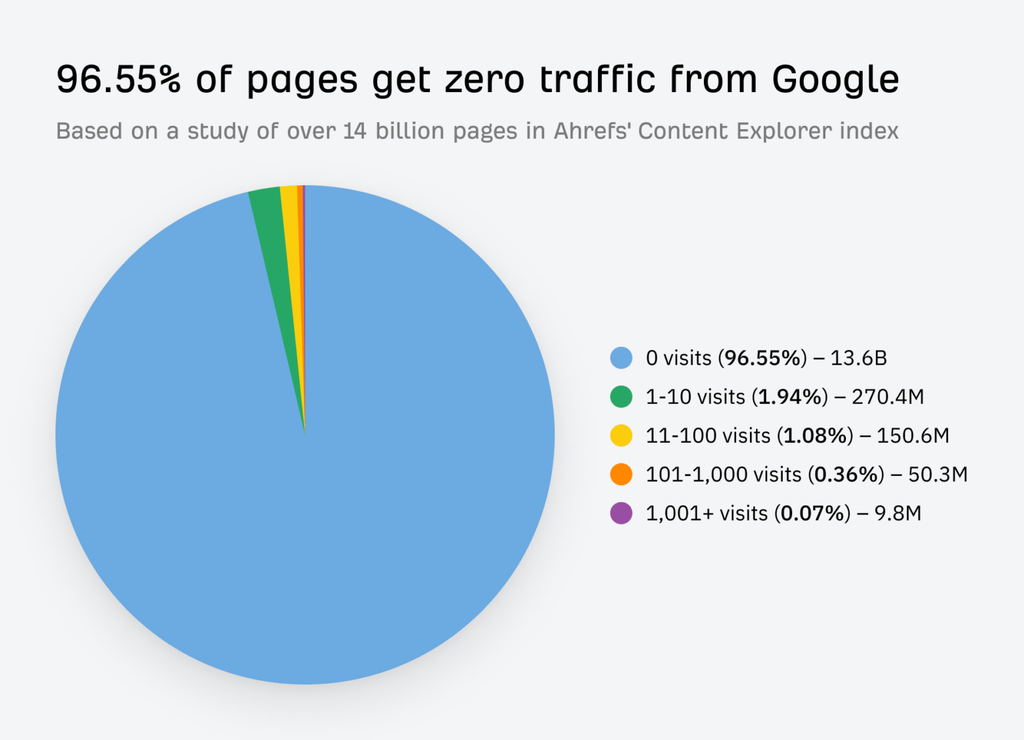
An Ahrefs study of around 14 billion pages found that 96.55% received no estimated organic traffic from Google. Among the reasons Ahrefs identified were low search demand, insufficient backlinks for competitive topics, and content that failed to match search intent.
Competition matters too. A new site such as doggrooming.it.com may struggle to rank for a broad term such as "dog grooming." A specific topic such as "how often should a golden retriever be groomed?" answers a narrower need and may face less competition.
AI tools can help organize keyword research without replacing search-volume data. For example:
Prompt: "I run [type of business] at [domain]. List 20 specific questions potential customers may search before buying [product/service]. Group them by informational and commercial intent. Suggest a suitable page type for each."
- Match the page to what the user wants
Keywords identify the subject. Search intent explains what the person expects to find.
Someone searching "best payroll software for restaurants" is probably comparing options. A search for "restaurant payroll software pricing" suggests a different stage of the buying journey. One generic homepage may struggle to answer both.
Different page types can cover different needs. An educational article can explain a problem, while a focused landing page can support a specific product, service, or campaign.
- Account for zero click searches and AI answers
A lack of clicks does not always mean a lack of visibility.
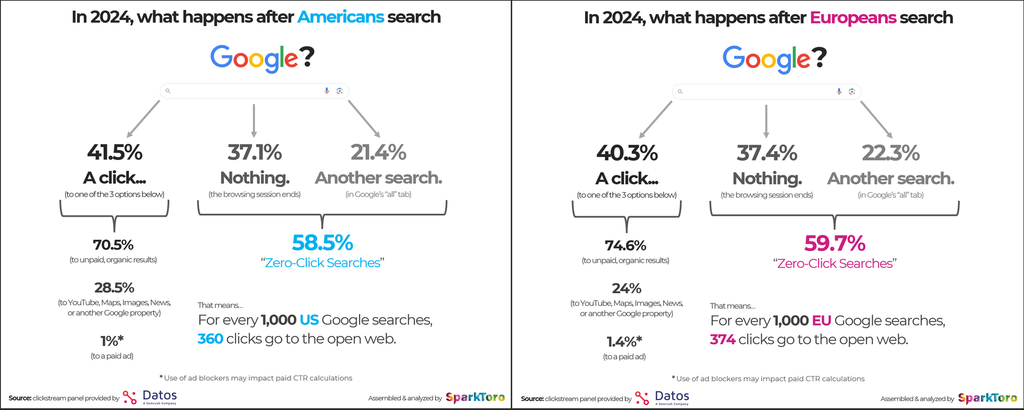
Zero click searches happen when someone searches but does not click a result. In a SparkToro and Datos study, 58.5% of US Google searches ended without a click.
AI-generated answers add another layer. A Pew Research analysis of Google search behavior found that users clicked a traditional result during 8% of visits where an AI summary appeared, compared with 15% of visits without one. Links inside the AI summary itself received clicks in just 1% of those visits.
This means businesses may need to look beyond clicks when judging visibility. Useful first-hand information, clear answers, reliable sources, and identifiable authors can give search and AI systems more context about a page.
Structured data markup can provide additional machine-readable information about products, organizations, articles, FAQs, and other page elements. It does not guarantee rankings or AI citations, but it can help systems understand what information represents.
Step 2: Create more routes into the website
Organic search is only one route into a website. A new website starts with few external signals. Relevant business directories, partner websites, digital PR, social media, email, local listings, communities, and paid campaigns can all create additional discovery opportunities.
- Direct traffic usually needs existing awareness
Direct traffic is often misunderstood. In analytics, it generally includes visits where the source cannot be identified, such as someone typing the URL into a browser, using a bookmark, or arriving through an untagged link.
A brand-new website will usually have little direct traffic because few people know the domain yet. For example, someone is unlikely to type freshbakes.it.com into their browser unless they have already seen the name on packaging, social media, an advertisement, a business card, or somewhere else.
Direct traffic therefore tends to grow alongside brand awareness. Offline marketing, repeat customers, word of mouth, PR, and consistent use of the domain across marketing materials can all contribute over time.

- Paid ads may be live without generating many visits
A paid campaign does not automatically create traffic as soon as it launches. Low ad traffic can come from a small budget, narrow targeting, low search demand, weak bids, limited geographic coverage, or ads that fail to win enough impressions.
Campaign setup can also restrict delivery. Ads may be under review, disapproved, scheduled for limited hours, or aimed at an audience that is too small. On search platforms, a new advertiser may also be competing with established businesses for the same queries.
The first useful check is usually the advertising platform itself. If a campaign has almost no impressions, the issue happens before the click. If it gets impressions but few clicks, the ad message, targeting, offer, or position may be contributing. If the platform reports clicks but analytics does not record them, tracking or campaign tagging may need investigation.
- Social, email and referral traffic need distribution
Publishing a website does not automatically place it in front of social media followers, newsletter subscribers, or visitors from other websites.
Social traffic depends on people seeing and engaging with posts that link to the site. Email traffic requires an audience and campaigns that contain trackable links. Referral traffic usually develops when directories, partners, publications, review sites, or other relevant websites link to the business.
For a new website with no traffic, this creates an important distinction: sometimes nothing is technically wrong with the site. It may simply have very few routes through which potential visitors can discover it.
AI can make the planning stage faster. These ChatGPT prompts include ideas for content, social posts, email sequences, and website copy.
Another prompt could turn one content idea into several traffic sources:
Prompt: "Create a promotion plan for this article: [URL/topic]. Suggest one LinkedIn post, one email angle, three community discussions where the topic may be relevant, and two follow-up articles. Avoid spam or promotional comments."
Step 3: Measure traffic that can lead to business
A channel-by-channel check can make the cause clearer:
- No direct traffic: the brand or domain may still have low awareness.
- No paid traffic: campaigns may have limited impressions, targeting, budget, or delivery.
- No social traffic: posts may have limited reach or may not send people to the website.
- No email traffic: the business may not yet have a subscriber base or active campaigns.
- No referral traffic: few external websites may currently link to the domain.
Looking at each source separately helps distinguish a website problem from a distribution problem. For many new businesses, building traffic means creating several ways for people to discover the site rather than relying on a single channel.
And to add to that - more visitors do not automatically mean more customers.
Imagine that customdesks.it.com attracts thousands of people looking for free DIY desk plans, while the company sells finished custom office furniture. The visits are genuine, but many users have little reason to buy.
Alongside sessions, businesses can therefore track actions such as purchases, quote requests, phone calls, appointments, and email sign-ups. Comparing those actions by landing page and traffic source shows which channels bring visitors who are closer to becoming customers.
A website with no traffic rarely has one mysterious problem. Measurement, indexing, search demand, intent, promotion, and conversion form a chain, and a weakness at any point can limit results.
Looking at that chain in order makes the situation easier to diagnose. It can show whether the real problem is technical visibility, weak demand, zero click searches, or simply traffic that was unlikely to buy in the first place.
FAQs
Why am I not getting traffic to my website?
Common reasons include analytics problems, pages that have not been indexed, low search demand, competitive keywords, content that misses search intent, few relevant external links, or limited promotion. Search Console is useful for separating "Google cannot find my pages" from "Google displays my pages but people are not clicking."
Is AI killing website traffic?
AI is changing click behavior, especially for searches that can be answered directly on the results page. Research has found lower click rates when Google displays AI summaries, although zero click searches existed long before generative AI became widespread. The impact varies by topic because some searches still require people to visit a website to compare, buy, book, or explore further.
How to get traffic to your new website?
Traffic to a new website usually comes from several sources over time. A common process includes checking analytics and indexing, researching real search demand, matching content to search intent, strengthening internal links, earning relevant mentions or backlinks, and promoting the site through channels such as social media, email, local listings, communities, or advertising.
Why is my website getting traffic but no sales?
Traffic may fail to convert when visitors have the wrong intent, the offer does not match the page, important information is missing, or the purchase journey creates friction. Comparing conversions by source and landing page can help distinguish a traffic-quality problem from a website conversion problem.
How to get traffic that buys to your website?
Traffic with stronger buying potential often comes from searches and channels connected to a specific customer need. Pages covering pricing, comparisons, product availability, local services, use cases, and specific problems tend to sit closer to a purchase decision than very broad informational topics. Informational content can still play an important role earlier in the customer journey.
Need advice for launching your business online? Visit it.com Domains blog and follow us on social media.

Read also

Tips and Tricks
Phishing with Fake Impersonating Domains: How Business Can Recognize It and Guard
- 10 min read