Industry News Digest: August 2026
- by Ilona K.

Table of contents
- ICANN Receives Over 1,600 Applications for New Domain Extensions
- Study: 58 % of Users Can’t Remember Companies’ Domains
- A New Standard Could Make Domain Sales Easier to Discover
- OpenAI, Google, and Others Unite in Defense Against AI Attacks
- Google Changes How it Demotes Websites in Search Results in Europe
- Google Completes August Anti-Spam Algorithm Update
Welcome to our monthly Industry News Digest. Explore new online trends and domain industry news to stay up-to-date. Here’s a summary for August 2026:
ICANN Receives Over 1,600 Applications for New Domain Extensions
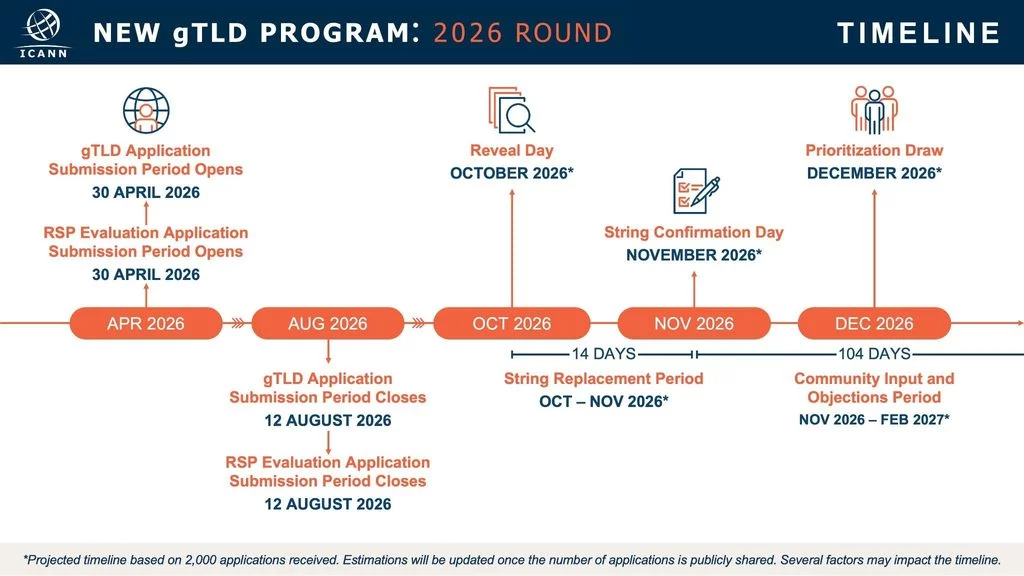
ICANN received approximately 1,600 applications in the second round of the New gTLD (generic top-level domain) Program. Applications closed on August 12. This represents a decrease of approximately 17% compared to the first round, but exceeded expectations; interest in new gTLDs was previously expected to be significantly lower as many options had already been snapped up.
Approximately 1,100 applications now include a fallback domain extension. This option was introduced in the second round of New gTLD registrations. If there are multiple applicants for a client’s preferred option and their bid is unlikely to succeed, they can switch to a fallback extension and register that instead. Information on who applied for which gTLDs will be published during Reveal Day, which is expected to take place no later than nine weeks after the application deadline.
Why should you care? Interest in new gTLDs remains high, even more than ten years after the first round. The second round of the program opens new opportunities for companies to create their own domain extensions associated with brands, products, or specific areas of activity.
Launching a custom domain extension requires not only submitting an application but also preparing the infrastructure for its subsequent management. It’s therefore essential for companies to select an evaluated RSP (Registry Service Provider) in advance, which will provide technical support and manage the domain extension.
it.com Domains is an ICANN-evaluated RSP that has created a registry platform for launching and managing new TLDs based on its registry experience. Our team has fully taken into account all the nuances of working with domain extensions that may be of use to TLD owners.
Source: ICANN
Study: 58 % of Users Can’t Remember Companies’ Domains
An Atom study found that 58% of users have at least once been unable to find a company’s website because they couldn't remember or spell its domain name correctly. Another 18% weren’t sure whether they had encountered this problem.
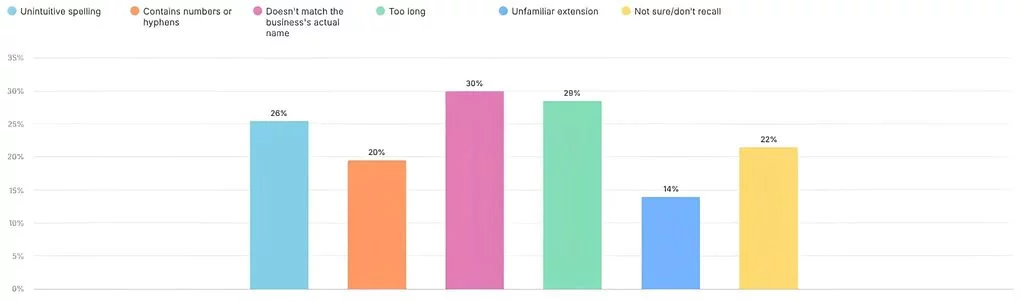
Thirty percent of respondents cited a mismatch between the domain name and the brand name as the top factor preventing them from remembering an address. Next came domain length (29%), complex or unconventional spelling (26%), and the use of numbers and hyphens (20%). An unfamiliar domain extension ranked last, cited by only 14% of respondents.
Why should you care? A domain is part of the user experience. If the address is difficult to remember or reproduce, it may be more difficult for users to return to the site or find it on their own.
When choosing a domain, criteria such as connection to the brand, ease of spelling, and memorability are just as important as brevity.
Source: AtomRadar
A New Standard Could Make Domain Sales Easier to Discover
The IETF (Internet Engineering Task Force) has introduced a standardized format for publishing information about domains available for sale directly in DNS (domain name system) records. A special TXT record confirming domain ownership can include the price, currency, contact information, a short description, and a link to a page with additional information.
This initiative aims to make the domain market more open; potential buyers will be able to automatically find domains listed for sale without the need for marketplaces or brokers. The standard is already in use in the .nl extension, where approximately 250,000 domains have DNS record-based sale information.
However, this approach has limitations. DNS records are publicly accessible, so contact information posted in them can be a source of spam or DNS abuse. Furthermore, owners will have to carefully monitor the links and other information they publish in the record.
Why should you care? If adopted more widely, this standard could help create new tools for discovering domains for sale and make parts of the domain sales process more automated.
This provides another way to signal that a domain is available, while buyers and domain marketplaces could use the standardized data as an additional source of information when searching for domains.
Source: Domain Incite
OpenAI, Google, and Others Unite in Defense Against AI Attacks
Over 100 companies from the artificial intelligence (AI), technology, finance, and cybersecurity sectors have signed an open letter calling for stronger joint measures against AI-enabled cyberattacks. Participants include OpenAI, Google, Anthropic, AWS, Cisco, Cloudflare, CrowdStrike, Microsoft, Oracle, Perplexity, and Hugging Face.
The companies warn that as AI advances, cyberattacks could become more widespread and difficult to detect. Proposed measures include using AI to strengthen defenses, monitoring AI agents’ actions, ensuring accountability, and sharing information between companies and security professionals.
Why should you care? AI is already being used to protect infrastructure, find new solutions, and speed up various processes, but the technology also has the potential to automate certain stages of cyberattacks. This means securing AI systems is becoming a shared concern for developers, businesses, and cybersecurity professionals.
New threat scenarios should be considered when implementing AI, with special attention paid to the monitoring of autonomous systems, access control, and protecting digital infrastructure.
Source: Engadget
Google Changes How it Demotes Websites in Search Results in Europe
Effective August 30, Google has changed its policy against so-called site reputation abuse for users in the European Economic Area (EEA). The company no longer applies manual actions to demote websites for this violation in the 27 EU countries, as well as Iceland, Norway, and Liechtenstein.
The policy applies to situations where an authoritative website hosts third-party digital assets, such as commercial content from partners, in order to leverage the site's accumulated search authority. However, Google has retained the restrictions outside the EEA.
This change is due to concerns from European regulators, who pointed out that as well as affecting SEO (Search Engine Optimization) abusers, the previous policy could have affected legitimate publishers who work with commercial partners.
Why should you care? The change demonstrates that search ranking rules are increasingly dependent not only on Google's algorithms but also on the regulatory frameworks of individual regions. Website owners targeting international audiences need to be aware of the differences in how search policies are applied across markets.
However, posting third-party content on an authoritative site still requires caution: the change in approach to manual demotion in Europe doesn't mean Google has completely abandoned the fight against search engine manipulation.
Source: Reuters
Google Completes August Anti-Spam Algorithm Update
Google has completed the August 2026 Spam Update, which ran from August 18 to 21. The update was rolled out globally and in all languages. This is the third major search engine update aimed at combating spam in 2026, following the March and June updates.
Google didn’t announce the introduction of any new spam types as part of the update or publish a description of the changes made. Industry observations indicate a possible intensification of the fight against mass-produced AI-powered content aimed primarily at generating search traffic. Google specifically emphasizes that the mere use of AI doesn’t make content spam.
However, early data from Search Engine Land suggests that the update caused noticeable ranking volatility across websites, with some sites reporting significant changes in organic visibility. The impact varied by site and industry, and it may take additional time to determine which types of content and websites were most affected.
Why should you care? This latest update demonstrates that Google continues to improve its content quality assessment systems and combat large-scale attempts to manipulate search results. This is another incentive to create content tailored to users’ needs, rather than simply gamed to optimize keyword coverage. Using AI is not in itself a problem, but publishing large volumes of automatically generated content without reviewing its accuracy, originality, and usefulness can undermine a site’s search performance.
Now the update has been made, changes in organic traffic should be assessed against the period before August 18. A separate check should also be carried out of the site’s compliance with Google’s current anti-spam requirements.
Source: Search Engine Journal
Stay up-to-date with digital trends and news - visit it.com Domains blog and follow us on social media.

Read also