2025 Domain Sales and Acquisitions and 2026 Predictions with Tess Diaz, it.com Domains
- by Tess Diaz

Table of contents
Another year passed, and once again we reviewed the most significant domain sales and acquisition trends. Check out the most notable trends and what to expect in 2026 with Tess Diaz, Director of Channel Development at it.com Domains.
Last year, we looked at 2024 domain sales as a signal that the market had stabilised after years of speculation-driven cycles. Premium .com domains continued to dominate the top end, AI-related names were beginning to gain credibility, and buyers were clearly more deliberate about where they deployed capital.
In hindsight, 2024 now looks like a transitional year. Because 2025 didn’t just build on that foundation — it redefined the rules of the market.
According to Domain Name Industry Brief (DNIB), 2025 ended with 386.9 million domain name registrations across all top-level domains (TLDs), an increase of 8.4 million domain name registrations, or 2.2% in Q4 vs Q3 2025. Domain name registrations also increased by 22.7 million, or 6.2%, year over year.
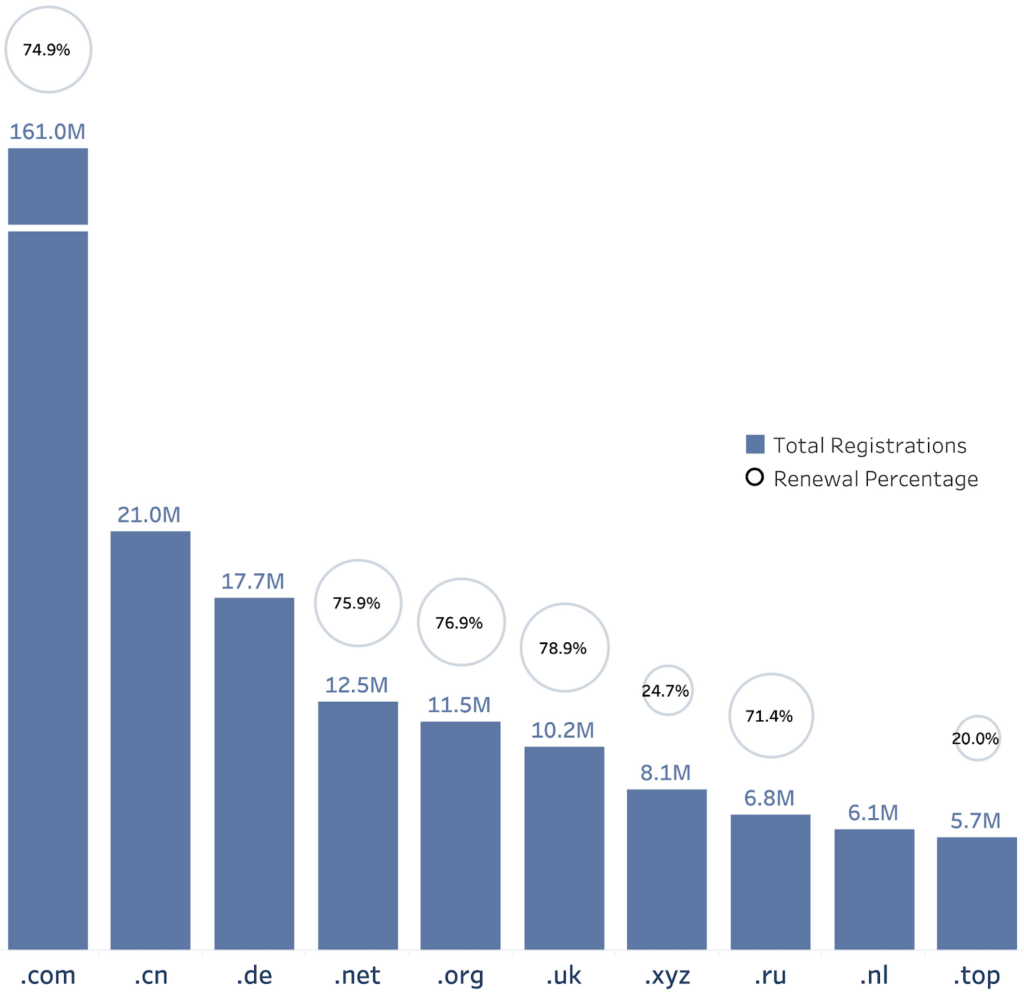
Apart from the new registrations, we’re closely looking at aftermarket sales to get a better view of market changes and expected trends. While private sales are often significant in the aftermarket, we have looked into public sales and acquisitions only - and here’s how the market looked like last year.
2025 in Domain Name Sales & Acquisitions
The publicly reported aftermarket data from NameBio shows that 190,109 domain sales above $100 were recorded in 2025, generating $314.7 million in total value, compared to $188.8 million across 144,974 sales in 2024. That represents a 67% year-over-year increase in USD volume, alongside a 31% increase in transaction count.
While the above numbers show a significant growth, the overall structure of the Top-100 sales remained largely consistent year over year, with only a slight increase in ccTLD transactions — though this growth is partly influenced by extensions like .io, which, despite being a country-code domain, are increasingly used and perceived more like generic TLDs (e.g. forward.io).
| Year | Generic gTLDs (.com/.org/.net) | New gTLDs | ccTLDs | Total |
| 2024 | 71 | 25 | 4 | 100 |
| 2025 | 69 | 25 | 6 | 100 |
When analysing the structure of sales, five prominent trends become clear.
.com Remains the Anchor
In both 2024 and 2025, .com remained the dominant extension at the top of the market. It continues to be the preferred choice for:
- global consumer brands
- horizontal platforms - companies or products that serve multiple industries or user groups, rather than focusing on one specific niche or vertical
- companies seeking long-term, cross-industry relevance
Importantly, the .com zone has surpassed 160 million registrations, and the .com zone still commands the highest trust amongst customers, despite the prior reports about the decline due to market saturation.
To understand the broader context, it’s useful to look at the full Top-10 public sales of 2025, all representing sales in the .com zone.
Top-10 domain name sales of 2025
| Rank | Domain | Price | Context |
| 1 | ai.com | $70,000,000 | Category-defining AI infrastructure asset |
| 2 | icon.com | $12,000,000 | Short, globally recognisable brand |
| 3 | commerce.com | $2,200,000 | Strategic bet on digital trade and platforms |
| 4 | fuse.com | $2,129,509 | Brandable convergence of energy, tech, and media |
| 5 | anything.com | $2,000,000 | Pure optionality and long-term brand flexibility |
| 6 | sword.com | $1,500,000 | Strong metaphor brand signalling strength and clarity |
| 7 | skins.com | $1,459,450 | Taps into gaming, cosmetics, and digital identity economies |
| 8 | gx.com | $1,200,000 | Two-letter scarcity with cross-language relevance |
| 9 | slash.com | $1,000,000 | Developer-native language meets modern branding |
| 10 | zh.com | $1,000,000 | Linguistic and geographic significance |
One of the most interesting and widely reported sales of 2025 was Icon.com, which sold for $12 million — one of the largest single-word .com deals in history. This transaction is ranked among the 6th largest publicly disclosed domain sales ever recorded.
What makes this sale especially intriguing isn’t just the price tag — it’s who bought it and why. The buyer, an AI-focused startup led by CEO Kennan Davison, positions itself as building “the world’s first AI CMO,” an artificial intelligence platform that aims to autonomously manage marketing strategies and execution for businesses. Acquiring Icon.com wasn’t simply about owning a premium word — it was a foundational brand infrastructure decision that instantly signals category authority, trust, and leadership in a crowded AI market.
Several of other .com deals were brokered through established domain name brokers, reinforcing a broader trend: the high end of the domain market is now dominated by professional buyers and sellers who understand market value, not just opportunistic flippers.
What didn’t change is just as important: sales below $100 remained largely flat, meaning this growth was not driven by hype or mass speculation. It was driven by intentional, strategic acquisitions. And nowhere was that shift clearer than at the very top of the market.
The Sale That Reset Expectations: ai.com
When this year, ai.com announced it had acquired the domain for $70 million in 2025, it instantly became one of the most consequential domain transactions ever recorded.
Unlike many high-profile domain deals of the past, this was not a rebrand or a marketing-led acquisition. The buyer — Kris Marszalek, Founder and CEO of Crypto.com — was acquiring something far more fundamental: category authority.
AI is no longer a product category. It’s a layer that underpins:
- search
- productivity software
- developer tooling
- enterprise automation
- consumer interfaces
Owning ai.com is equivalent to owning internet.com in the 1990s or cloud.com in the 2010s — a signal that the buyer intends to operate at the centre of the ecosystem, not at the edges.
What makes this deal especially important is contrast. In 2024, the largest sales — rocket.com ($14M) and gold.com ($8.5M) — reinforced the enduring value of premium dictionary .com domains. Those were powerful, familiar signals. ai.com was something else entirely. It didn’t just exceed prior prices — it reset the ceiling.
AI Domains: From Trend to Infrastructure
The .ai extension — formally the country code for Anguilla — has exploded in use as a global namespace for AI-related brands and products, with close to 1 million registered .ai domains worldwide by late 2025. That growth reflects a broader shift in how companies view the extension: not as a novelty, but as native territory for AI-centric products and services.
Multiple .ai names in the 2025 top-100 list fetched strong prices. Verified sales like wisdom.ai ($750,000), cloud.ai ($600,000) and law.ai ($350,000) show real operating value tied to functional categories: strategic intelligence, cloud integration and legal tech respectively.
In addition to the steady growth of top sales in the .ai zone (23/100 in 2025 vs 17/100 in 2024), the most striking year-over-year change was the rise of AI domains as functional assets. In 2024, AI names such as sound.ai, girlfriend.ai, and fantasy.ai reflected experimentation. They were brand-led, consumer-facing, and often novelty-driven.
In 2025, high-value AI sales included:
- cloud.ai ($600,000)
- law.ai ($350,000)
- weather.ai ($150,000)
- blockchain.ai ($405,000)
- agenticai.com ($120,000)
These names aren’t playful. They’re descriptive. They tell users exactly what to expect. This is a classic sign of market maturity: when buyers stop asking “Is this acceptable?” and start asking “Is this clear?”
A More Liquid, More Rational Mid-Market
Another defining feature of 2025 was the density of sales between $110k and $300k. Unlike previous years, where pricing often felt erratic, 2025 showed repeated agreement around what constitutes a high-quality domain:
- clear meaning
- strong category relevance
- scalability across products and geographies
This stands in contrast to earlier cycles where growth was driven by low-value registrations and rapid flips. In 2025, the money moved up the stack.
A clear illustration of the more liquid, more rational mid-market in 2025 is the sale of serp.com for $210,000 and export.com for $163,000. Both names sit comfortably within the dense $150k–$300k band that defined much of the year’s activity, and neither price feels speculative. serp.com speaks directly to search, SEO, and AI-driven marketing — a term with established commercial relevance and immediate product alignment.
Meanwhile, export.com is a timeless, globally understood business term with clear applicability across trade, fintech, and logistics. In both cases, buyers paid six-figure sums not for abstract brandability, but for functional clarity and operator value — a strong signal that 2025’s mid-market pricing was grounded in real-world business logic rather than hype.
But 2025 marked a shift away from the idea that everything must live on a .com. Instead, buyers increasingly matched extension to intent.
Specific, Short and Intent-Driven
Beyond headline prices, the top sales reveals three important shifts.
1. Domains Are Being Bought for Position, Not Just Branding
commerce.com and skins.com are good examples. These aren’t abstract names — they sit at the centre of high-growth economic activity. Digital commerce and digital identity are expanding simultaneously, and the buyers of these domains are positioning themselves where those curves intersect.
2. Optionality Is Still Valuable — But Less Dominant
Names like anything.com remind us that pure optionality still commands a premium. However, these deals are now the exception rather than the rule. The majority of high-value purchases in 2025 were tied to specific sectors and use cases.
3. Short Domains Still Win — Across Extensions
One and two-letter domains (gx.com, zh.com, r.org) continue to perform well, reinforcing that scarcity remains a fundamental pricing driver. What’s changed is that scarcity is now evaluated within context, not in isolation.
2026 Domain Sales: Looking Ahead
Looking at 2024 and 2025 together, several forward-looking signals become impossible to ignore.
Category Ownership Will Outperform Brand Ownership
In 2026, the highest-value domain acquisitions will increasingly be those that define categories, not just brands.
Founders and operators will pay premiums for domains that:
- anchor entire ecosystems
- sit at the intersection of multiple industries
- remain relevant even as products evolve
This is why ai.com mattered so much — it represents the ultimate category asset.
Extension Choice Becomes a Strategic Decision
.com will remain the gold standard for universal brands, but other extensions will continue to gain ground where they offer semantic efficiency.
- AI products on .ai.
- Infrastructure on purpose-built extensions.
- Regional platforms on trusted ccTLDs
By 2026, choosing the “wrong” extension will feel less like a branding risk — and more like a strategic misalignment.
Domains Will Be Treated as Long-Term Infrastructure
Perhaps the most important shift is psychological. Domains are no longer being treated as marketing line items. They’re being treated as foundational assets, similar to:
- data infrastructure
- regulatory positioning
- platform architecture
As AI, regulation, and user expectations evolve, companies will increasingly want names that can scale with them — not constrain them.
2024 showed that the domain market was resilient. 2025 showed that it had matured.
At it.com Domains, we see this evolution play out every day. Founders are no longer asking which domains are trendy — they’re asking which names will still make sense five or ten years from now.
And if 2025 taught us anything, it’s this: the future of naming belongs to those who think beyond launches, beyond cycles, and beyond convention.
Keen to stay on top of the domain industry trends? Visit it.com Domains blog and follow us on social media.

Read also

Expert Opinion
Does Brand Storytelling Matter in 2026? Experts Share How to Tell Your Brand Story Right
- 9 min read

Expert Opinion
- 5 min read